Shipping Is a Habit, Good Enough Is the Cut
Years of not knowing when a song is finished, a habit borrowed from shipping software, and the small releases that are slowly teaching me where good enough lives on the way to an album.
I make music under the name We Eclipse, and if you go looking there are two singles of mine out in the world: Lagom and, more recently, Constellations. Both sit on Spotify, Apple Music, Tidal, Deezer, YouTube Music, etc etc.
(Lagom, for the uninitiated, is a Swedish word for just the right amount, neither too much nor too little. The Swedes have a word for everything, it seems.)
Both releases are steps toward a larger LP, which is the thing I have wanted to make for longer than I would care to admit. This piece is mostly musing on how the steps got taken at all, because for a good many years they were not.
Related Post
We Eclipse
The Cut I Never Made
For most of the years I have been making music, the decision I struggled with most was when to stop. Every track reaches a point where it is good enough to put out, and mine had a habit of sailing serenely past that point and carrying on regardless.
My process, such as it is, goes roughly something like this:
- Writing
- Arranging
- Listening
- Tone and sound design
- Recording
- Arranging again
- Mixing
- Mastering
- Final production (includes a car test)
You may notice arranging turns up twice, and that second lap tells you most of what you need to know. Every one of those stages is a place where you can call it good enough and move on, or go round again, and the list above only records the one extra lap I am willing to admit to in public.
Some days it is less a lap and more the roundabout at the top of the Champs-Élysées: twelve exits, no lanes, and me going round and round the Arc de Triomphe looking for the one that leads to a finished song (would recommend as an experience nevertheless).
There is a certain attraction in calling this perfectionism, a word that gets handed out with abandon, and I think the truth is knottier than that. Psychologists have a better word for it. Barry Schwartz and colleagues split people into maximisers, who hunt for the best option, and satisficers, who stop at good enough, and found the maximisers did more searching and comparing and were less satisfied with what they ended up with. The trouble is the search, more than the standard.
Related Post
Maximizing Versus Satisficing: Happiness Is a Matter of Choice (Schwartz et al., 2002)
As I write this the album is in production, all fifty or so minutes of it. Finding the time for it is hard enough, and being as brutal with it as it needs is harder still.
I have come to think of "good enough" as a cut, in the old sense of cutting a record. It is the moment a piece of work comes loose from all the revision clinging to it, and for years I lined it up on tracks without ever once making it.
Software, funnily enough, I never had this trouble with.
A Habit From The Day Job
Shipping software is a habit I picked up long before I thought to call it one. You build the smallest thing that does the job, put it in front of people and learn from what happens next. MVP is a fairly tired acronym at this stage (bless it), but the idea under it holds up well. A release is how you find out whether the thing was any good.
Software also hands you a definition of done, which helps more than we tend to give it credit for. The tests go green, a reviewer approves, the ticket slides across the board. You can argue with any of those signals, and engineers generally do, but they exist, and when they all agree you ship and get on with your day.
I rather assumed the habit would follow me over to the music.
No Test Suite For A Chorus
Music, it turns out, has no test suite, and nobody is coming to approve the pull request. A song is personal in a way a pull request rarely manages, and the person judging it is the same person who wrote it and has heard it more times than any listener ever will. The target moves with every listen. What sounded huge on a Tuesday sounds thin by Thursday, and the only thing that changed in between was me.
There is another difference that took me a while to notice. Professional software I build in teams, and music I make mostly alone. A team spreads the deciding around. Someone else sets the deadline, someone else reviews the change, and a call that goes wrong is shared out among everyone who agreed to it. On my own, every one of those jobs falls to the same person, who is also the one who has to like the result. Nobody nudges me to ship, and nobody tells me a take is fine once I have stopped being able to hear it. I can see why bands often move faster than one person on their own. Each taste keeps the others honest, and when it works, they fuse into something a little magical that none of them would have found alone. It is also a large part of why artists bring in a producer at all. People are very important to the creative process.
I wrote a while back about Rick Rubin, the producer who cheerfully admits he cannot work the desk and gets paid for his taste regardless. The bit of that interview I keep coming back to is the second half of what he said, that he is decisive about what he likes and what he does not. Taste tends to get the headlines. The decisiveness is what lets a record leave the room, and it was exactly the part I was short on. I could hear what was wrong with a mix well enough. What I could not do was look at the remaining wrongness and decide it was fine.
Related Post
The Producer That Couldn't
Small Releases As Reps
So I tried stealing the habit wholesale. Instead of aiming straight at the album, I set myself smaller goals, the musical version of an MVP: something finished and out on the platforms, however modest.
The first of these was also the first record I produced myself, start to finish, and the first I put out to the streaming platforms under my own steam.
On the site, Lagom now sits under past releases and Constellations is the current one. A single teaches you the whole path end to end, from an idea you are fond of to a link you can send your friends, at a size where a mistake only costs you one song. The second asks the same questions again, with the excuse of beginner's luck gone.
Each one forced the call I had spent years dodging. At some point I had to make the cut and let the thing go, warts and all.
Early Commitment Yields Earlier Movement
These days everything happens in Reaper, and a song lives in two projects before it gets anywhere near a mix.
The first is a scratch project, for the basic layout and getting the feel down. Nothing in it has to be good. It only has to tell me what the song is.
The second is the tracking project, for the raw recordings, and this is where I required the most change. For most of my time making music I would end up endlessly tinkering with amp sims, tones, EQs and effects, round and round, with the song itself waiting patiently in the corner. Analysis paralysis and tone chasing are common enough problems.
Now, in tracking, I commit to tones as quickly as I can. I only ever record with the actual tone, like it or not later. It forces a loop I never used to have: sample, commit, move on. That goes for every instrument, maybe less so for synths and field recordings.
There is research behind this too, as it happens. Daniel Gilbert and Jane Ebert found that people prefer decisions they can undo, yet the ones who could swap a photograph they had chosen ended up liking it less than the ones who could not. Keeping the door open stopped them settling into the choice. An amp sim I can re-tweak forever is that door, and recording the actual tone closes it.
Related Post
Decisions and Revisions: The Affective Forecasting of Changeable Outcomes (Gilbert and Ebert, 2002)
So I went a step further and handed the door to hardware. The rack below exists to make me choose early and often, so fewer choices pile up waiting for me later. A Klark Teknik 76-KT and 2A-KT handle the compression, a Lindell LiNTEC handles the EQ, and between them the tone is shaped in the analogue realm on its way in. By the time it reaches Reaper it is printed, set in amber like the glow of those meters, with no plugin lurking to talk me out of it.
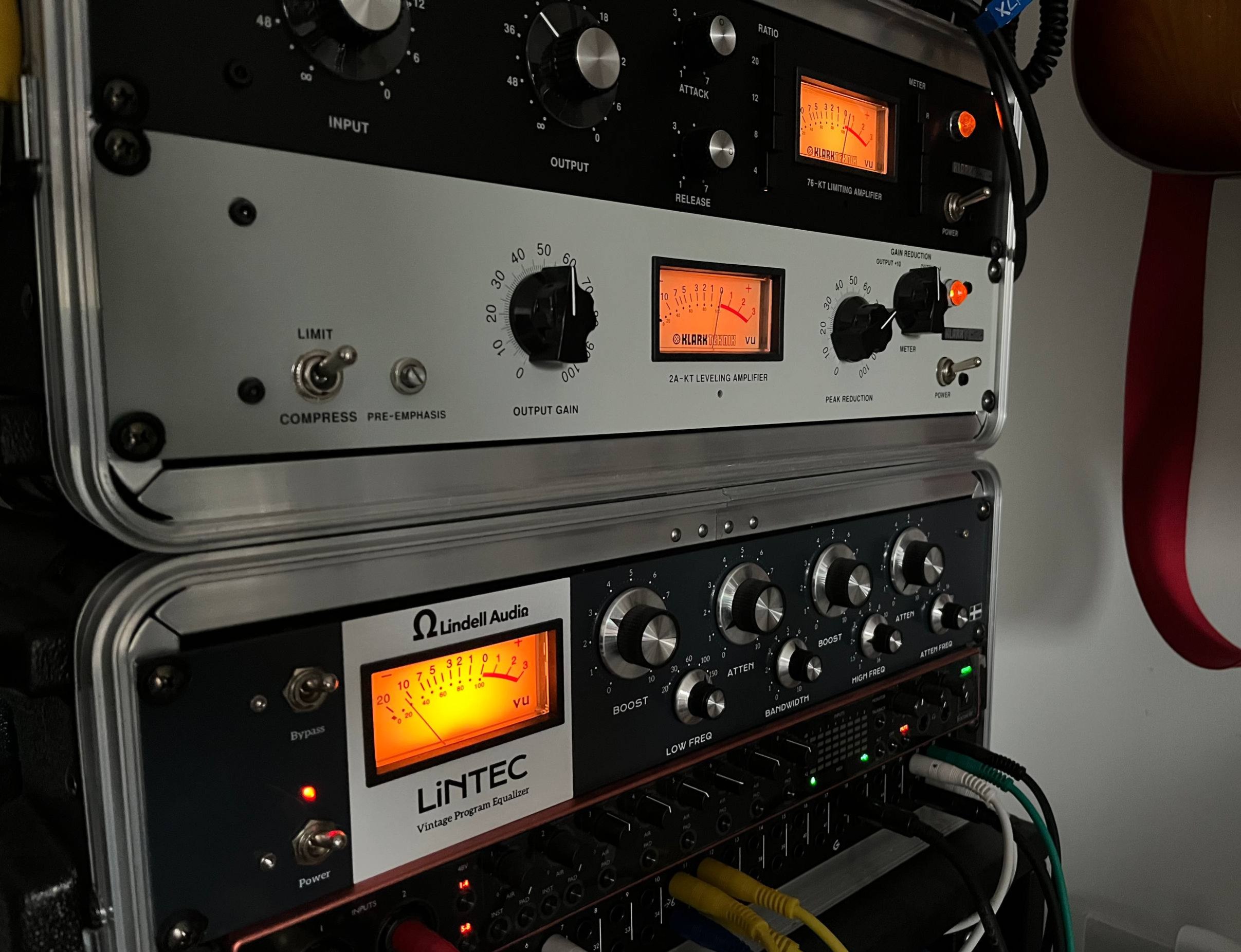
If I have a secret sauce, it is certainly a plain one, with very little glamour sprinkled on top.
Fewer decisions, made sooner, and made where no transient mood or preference can turn me backwards.
Once tracking is good enough (there it is again), the mix comes next, and the mix turned out to be the nearest thing music has to a test suite. The chorus still has none, but the mix is a blend of science and taste. It is either balanced or it is not. If the tracking was done well, mixing is a breeze. If the tracking was rushed or half-arsed, mixing is a slog, because you end up reshaping the tone and the vibe at the stage that was only ever meant to balance them. A mix done well makes mastering a doddle too.
Both the mix and the master also have to pass the car test. Driving takes focus, visually and sometimes by ear, but it is a loose sort of focus, and it is easy to engage with music while you drive. That is close to how most people will actually hear the thing, half listening while doing something else, and a long way from me hunched over the monitors listening for problems. Sadly, a mix that fails it badly enough can send me all the way back to tracking.
At the end, something like this is expected:
lagom
├── lagom-master
├── lagom-mix
├── lagom-scratch
└── lagom-tracking
A nightmare mix rarely limps on to mastering, either. More often it ends one of three ways: a full wipe, where the project is dead and no more work goes into it; back to the scratch project to rethink the song; or back to tracking to record the parts again. There are a lot of ways for this to go round in circles.
Each stage hands the next one whatever it was given:
Anyone who has fixed a bad data model three services downstream will recognise the shape. The cut is cheapest early, while committing costs a few minutes, and every stage after tracking pays for whatever I was too timid to decide there.
What Is Done, And Was It Enough
Here is the part I did not see coming. Once the releases were small enough to finish, the bottleneck simply moved house. The deciding got easier and the remembering got harder: which tracks are done, which are nearly done, which take of the vocal was the one I liked, and whether a song I signed off months ago was genuinely good enough or whether I was just tired that evening, with a bad case of listening fatigue to boot.
What I do not have is the folder of final, final2 and final_ACTUAL that
haunts some home studios. I am happy to overwrite and commit to one source of
truth, which is the tracking rule again in another form. The project file tells
me where a song is. It does not tell me why I stopped where I did.
It is the same problem I wrote about in the Friday digest, where I had written everything down and still could not tell you what happened that week. A song stretched over months has it worse, because what slips away is how a mix felt on the night you made the call. "Good enough" is a judgement made in one moment that you then have to live with in another, and if you cannot remember why you made it, you start prising it back open.
Related Post
A Digestive for an Agentic Friend
The Next Cut
Which brings me back to the album, fifty minutes of it, short on time and short on brutality, and by some distance the biggest cut yet.
It is the same question asked at a larger size: more songs, a longer stretch of time and a great many more chances to lose the thread or reopen a decision I had already made. Fifty minutes is a lot of music to be brutal with. The two singles were reps for exactly this, for the deciding and for the keeping track of what was decided, and I have not made the cut on this one yet.
Lagom, was a ruthless outcome-first exercise at breaking old routines.
Whatever else was meant by it at the time, it reads now like a note left for whoever was going to make the album. Just the right amount, and then make the cut. Don't overthink it.
In the meantime, both releases are up on weeclipse.ie, good enough (even if I noticed flaws soon after) and out in the world, which is more than can be said for most of what came before them.
I have a deep sense of respect for the professionals who do all of this on a budget and on a schedule, and still keep going through hell and high water. Some weeks I cannot get beyond the tracking stage. If there is nothing coming, nothing comes. I can force myself to write code on a bad day, and I have never once been able to force myself to write music.
I get to wait for it and make the cut when I am ready. They have to make it on a deadline, with their livelihood riding on it, and then do it all again for the next record.